 Here is a picture of #14 Green and you can see the Wet Wilt damage running along a drain line of the Green. This Green is surrounded by trees and has a lower elevation than the rest of the property providing almost no air movement. Luckily for us most of the Wet Wilt areas are small and surrounded by healthy turf. When the weather breaks and we get out of the 90's we should see these areas recover nicely.

Sunday, July 24, 2016
Wet Wilt
Some may have noticed a few of our Greens looking a little rough. Unfortunately the 1" of rain we had on Monday when heat index's have been over 100 degrees has created some problems. The Greens surrounded by trees, mostly on the back nine suffered Wet Wilt and are looking a little thin. It may appear these areas are "dry" or even have some disease but unfortunately neither of these are the case. Wet Wilt occurs when the plant is unable to release the excess water inside due to high temperatures and the water boils and burst the plant cells from within. The damage is most noticeable where the collar and Green meet, as well as on Greens with no air circulation.
 Here is a picture of #14 Green and you can see the Wet Wilt damage running along a drain line of the Green. This Green is surrounded by trees and has a lower elevation than the rest of the property providing almost no air movement. Luckily for us most of the Wet Wilt areas are small and surrounded by healthy turf. When the weather breaks and we get out of the 90's we should see these areas recover nicely.
Here is a picture of #14 Green and you can see the Wet Wilt damage running along a drain line of the Green. This Green is surrounded by trees and has a lower elevation than the rest of the property providing almost no air movement. Luckily for us most of the Wet Wilt areas are small and surrounded by healthy turf. When the weather breaks and we get out of the 90's we should see these areas recover nicely.

Cicada Killer Wasps
Most people see the wasps on #6 and #7 Greens and run in fear. Well don't be scared, these wasps are actually not harmful to humans. These monstrous wasps are Eastern Cicada Killers. They look more menacing than they really are. Unfortunately they create giant mounds of sand in the collars of our Greens so you may see some kids with tennis racquets taking care of these pests.


Monday, July 11, 2016
Vandalism
Unfortunately we had a group of golfers get a little too drunk over the weekend and did some major damage to the golf course. Not only were they disruptive to other golfers, threw trash all over the course, they also did a significant amount of damage. We are repairing all their havoc and appreciate all your patience during this process.


We were able to call the Elkton police who did a great job responding right away to confront these vandals. Thank you for all those who witnessed it and did something about it.
Venting
 Today some of the early golfers may have seen us running our Toro aerifier on Greens. The perception is we are "aerifying" Greens, however a closer look shows what we are actually accomplishing. These solid tines are 5" long and much smaller diameter than a coring tine. They are going 4" deep to allow oxygen into the soil. It is also alleviating compaction and creating channels through the organic matter layer. This lets the roots breathe, helps water get deeper into the soil to the roots, and loosens up high trafficked areas. With so many benefits it is easy to see why we do it.
The great advantage to using these small tines to vent the Greens is once the roller goes over it, you cant even tell we did anything. Heres a photo of the roller smoothing out the holes. You can see the non-rolled Green on the right just after we vented it. The ball putts nice and smooth on the section on the left where the cup is.


With 10+ days of 90+ degree weather later this week, its important to take advantage of this cooler weather.
Tuesday, June 21, 2016
Mechanical Damage
Most damage to a golf course is caused from things you would not expect. Mechanical damage is one of the biggest problems and we strive to keep the damage minimal. It is impossible to prevent completely and accidents do happen.
 You might notice some brown lines on our #2 Fairway up near the Green. This was caused by a hydraulic leak on one of our Fairway mowers. Luckily our operator noticed the leak right away which prevented much more damage. Our mechanic was able to fix the problem the same day, but unfortunately some damage was done. The fluid burns and kills the grass so we will have a little blemish until the grass grows in over it.
 The biggest problem lately has been the mis-application of fertilizer a few weeks ago. We are glad to see most of the overlaps did not result in any turf loss, but a few greens did get damaged. We experienced a rare problem called "Etiolated Tiller Syndrome" (ETS) in those overlaps which can cause turf loss in high traffic areas. Our #8, 10, 12, 14, and Practice Greens have a few trouble areas. It seems the effects of the fertilizer are finally starting to stop, the ETS is going away, and we can start addressing those problem areas on those Greens.
 Unfortunately a continued problem which hurts us most is golfers taking divots on our Greens. At least once a week we have to repair a divot on our Greens. If you know of anyone, or see anyone taking a divot on a Green please notify the Pro Shop. This is an act of vandalism and it would be nice to see this damage go away.
Damage to turf can come in a number of ways, but damage from machines and people always seems to be the biggest problem.
 You might notice some brown lines on our #2 Fairway up near the Green. This was caused by a hydraulic leak on one of our Fairway mowers. Luckily our operator noticed the leak right away which prevented much more damage. Our mechanic was able to fix the problem the same day, but unfortunately some damage was done. The fluid burns and kills the grass so we will have a little blemish until the grass grows in over it.
 The biggest problem lately has been the mis-application of fertilizer a few weeks ago. We are glad to see most of the overlaps did not result in any turf loss, but a few greens did get damaged. We experienced a rare problem called "Etiolated Tiller Syndrome" (ETS) in those overlaps which can cause turf loss in high traffic areas. Our #8, 10, 12, 14, and Practice Greens have a few trouble areas. It seems the effects of the fertilizer are finally starting to stop, the ETS is going away, and we can start addressing those problem areas on those Greens.
Damage to turf can come in a number of ways, but damage from machines and people always seems to be the biggest problem.
Friday, June 17, 2016
Staffing
With colleges entering summer break, we are finally fully staffed. We take great pride in looking professional while enjoying our job here at Patriots Glen National Golf Club. We also keep our equipment nice and clean while Eddie keeps it all running.


Tuesday, June 7, 2016
Bring out the brushes
Our verticutter breaking after 4 holes earlier this year has really left us in a bind. We finally got word that there is no fixing it, the machine is wore out from old age. This presented a big problem for our Greens. The variety of Bentgrass on our Greens is very thatchy and with all of the laid down grass it has been hard to get Green speeds up.
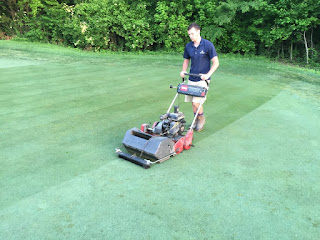 With any problem, there is a solution. Today we started standing the laid down grass blades upright using brushes. We first mowed the Green with an old walk mower fitted with a brush out front. It isn't fancy but it gets the job done. We were able to remove three times the amount of grass from the Green than from normal mowing.
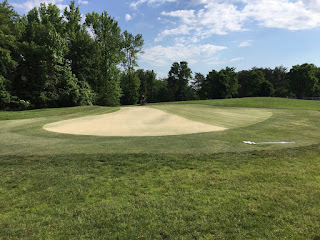 Next we put sand down on top of the Green and used our roller with brushes to push the sand down in between the blades of grass now standing upright. In the photo you can see what the Green looks like with the topdressing on the left and what it looks like after brushing on the right.
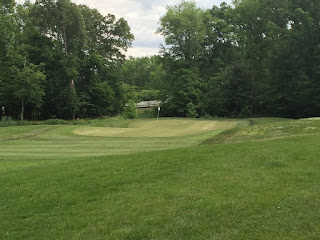 Then we use a light irrigation cycle to push the sand even deeper into the canopy of the Grass. The result you can see is a very good looking, much faster Green.
 With any problem, there is a solution. Today we started standing the laid down grass blades upright using brushes. We first mowed the Green with an old walk mower fitted with a brush out front. It isn't fancy but it gets the job done. We were able to remove three times the amount of grass from the Green than from normal mowing.
 Next we put sand down on top of the Green and used our roller with brushes to push the sand down in between the blades of grass now standing upright. In the photo you can see what the Green looks like with the topdressing on the left and what it looks like after brushing on the right.
 Then we use a light irrigation cycle to push the sand even deeper into the canopy of the Grass. The result you can see is a very good looking, much faster Green.
Subscribe to:
Posts (Atom)